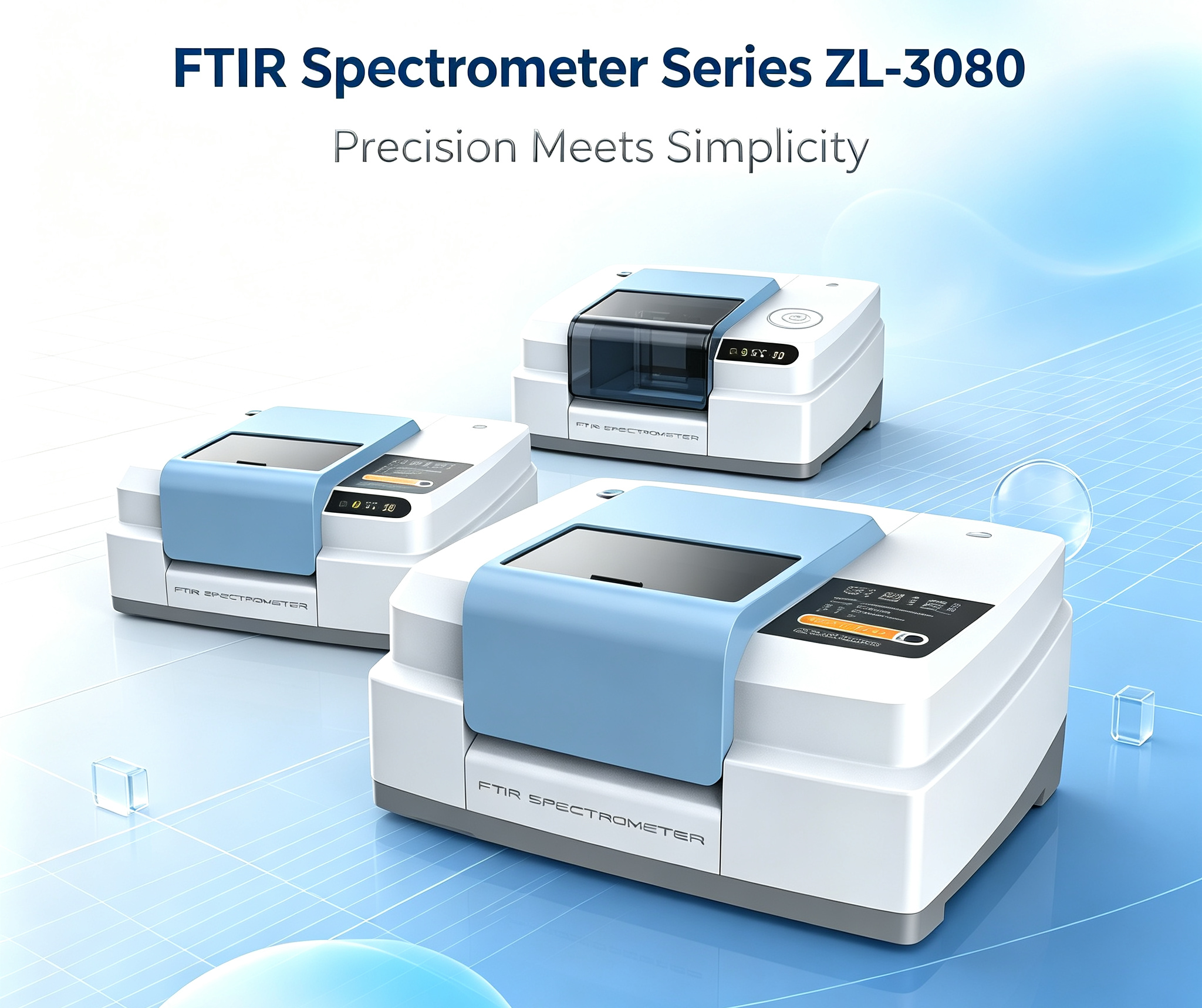
ZL-3080 Fourier Transform Infrared Spectrometer (FTIR) — A Practical Guide
Why Is FTIR the “Go-To Tool” for Contaminant Analysis?
The core need in contaminant analysis is simple: identify what it is and where it came from—fast. FTIR fits this need perfectly.
Here’s how: every organic contaminant—whether it’s resin, oil, adhesive residue, or flux—has its own unique molecular vibration frequency. When infrared light hits the contaminant, its molecules absorb specific wavelengths, creating a unique “spectral fingerprint.” FTIR then uses Fourier transform to convert the raw signal into a clear, readable spectrum. By matching this spectrum against a standard reference library, you can identify the contaminant in just minutes.
For common electronics contaminants, FTIR captures their characteristic peaks with precision. Take rosin flux residue as an example: it shows distinct peaks at specific wavenumbers—like C=O around 1730 cm⁻¹—making it instantly recognizable.